Best Angle Grinder: Buying Guide for Metal Fabrication & Concrete Cutting

Few tools are as versatile — or as punishing on cheap equipment — as the angle grinder. In a metal shop it's an extension of the fabricator's hand: cutting plate, beveling welds, and blending seams. On a jobsite it's the tool that chases cracks, scores control joints, and slices through cured concrete. But "metal fabrication" and "concrete cutting" demand different things from the same basic tool, and a grinder optimized for one will burn out fast doing the other.
This guide covers the specs that matter for both use cases, the safety features that are non-negotiable on any grinder, and dedicated sections for getting the most out of your grinder in metalwork and in concrete cutting.
Universal Specs: What Every Quality Grinder Needs
- Size class: 4-1/2" to 5" grinders are the general-purpose standard, spinning around 9,000–11,000 RPM. 7"–9" grinders trade RPM for torque and cutting depth, used for heavy concrete trenching and large-format work.
- Paddle (deadman) switch: If the tool is dropped or kicks back, the motor cuts instantly. This is the preferred switch for jobsites and anywhere safety regulations apply.
- Slide switch: Locks "on" — reduces hand fatigue during long blending/polishing sessions, but is more dangerous if the tool binds. Common in fabrication shops, but increasingly being phased out in favor of paddle switches with lock-on options.
- Kickback brake / electronic clutch: Internal sensors detect a sudden stop in wheel rotation (a bind) and halt the spindle in a fraction of a second. This single feature prevents a huge share of grinder injuries.
- Anti-restart protection: Prevents the grinder from powering on automatically if it's plugged in (or the battery is inserted) while the switch is already engaged.
- Tool-free guard adjustment: In real-world use you'll constantly reposition the guard for tight corners — if that requires a screwdriver, people skip it, which is a serious hazard.
Corded vs. Cordless
Corded grinders (11–15 amps) provide infinite runtime, run cooler under continuous load, and are generally lighter than equivalent cordless models — ideal for all-day shop use. Cordless high-voltage grinders (DeWalt 60V MAX FlexVolt, Milwaukee M18 FUEL) now deliver power equivalent to 13–15 amp corded tools and are essential for field mechanics, pipefitters, and mobile crews. The tradeoff: heavy continuous grinding — especially concrete cutting — can drain even a large 8–12Ah battery in under 15 minutes, making cordless better suited to intermittent or punch-list work.
For Metal Fabrication
A grinder built for metalwork needs to deliver sustained power without stalling under pressure. Look for a 5/8"-11 spindle thread, a dual-baffle cooling system to keep metal dust out of the windings, and a minimum of 11 amps for corded models.
Wheel and Disc Selection
- Type 1 cutoff wheels (0.045" thin) — turn the grinder into a mobile cutoff saw for bar stock, sheet metal, and rebar. Never side-load these — they're paper-thin and designed strictly for straight-line cuts. Side-loading can shatter the fiberglass mesh and send the disc apart as shrapnel.
- Type 27 grinding wheels (1/4" thick) — for weld prep, beveling, and chamfering thick steel edges.
- Flap discs (40–80 grit) — for blending welds flush with the base metal; provide a smoother finish than hard wheels with less gouging risk.
- Wire cup brushes/wheels — for stripping rust, paint, and mill scale before layout or welding.
Technique and Mistakes to Avoid
- Upgrade your abrasives. Zirconia alumina or ceramic wheels and flap discs self-sharpen as they fracture, cutting faster and lasting up to 4x longer than cheap aluminum oxide.
- Let the RPMs do the work. Pressing hard bogs down the motor, generates heat, and glazes the wheel. Keep a firm grip and let the tool's speed do the cutting.
- Clamp your workpiece. If stock shifts while plunging a cutoff wheel, the disc can shatter. Secure everything in a heavy-duty vise before pulling the trigger.
- Mind your angle. 15–30° for hard grinding wheels; 5–15° for flap discs, to use the maximum surface area of the overlapping flaps.
- Don't cross-contaminate metals. A wheel or wire brush used on carbon steel will embed particles that cause stainless steel to rust on contact. Keep dedicated, labeled wheels per metal type.
- Don't grind masonry with a metal-spec grinder. Fine concrete dust tears up motor bearings fast — if you're regularly cutting block or slab, you need a sealed, dust-extraction-ready grinder (see below).
For Concrete Cutting
Concrete cutting relies on brute torque, not just RPM — as a diamond blade grinds through aggregate and cement, the motor faces massive resistance. A standard 7-amp grinder will stall and burn out its armature. Concrete-ready grinders need a minimum of 13 amps for 4.5"–5" models, and a full 15 amps for 7"–9" models, plus epoxy-coated windings and sealed switches to keep silica dust from shorting the electronics.
When to Reach for a Grinder vs. a Gas Saw
A 14" gas-powered cut-off saw is the undisputed king of deep trenching, but it produces lethal carbon monoxide and is too heavy and unwieldy for vertical or overhead cuts. An angle grinder excels at chasing and widening cracks before epoxy injection, flush-cutting rebar, scoring shallow control joints, removing trip hazards, and making precise relief cuts before setting baseplates.
Choosing Your Grinder Size
- 7"–9" corded (heavy duty): 15 amps, 6,000–8,500 RPM, cuts up to 2.5" deep. Heavy (12+ lbs), but the mass helps absorb vibration on long scoring runs. Industry standard for deep cuts and prolonged use.
- 4.5"–5" corded (precision): 11–13 amps, ~11,000 RPM, cutting depth around 1.25". Compact and lighter — ideal for tight spaces, vertical wall cuts, and overhead work where fatigue matters.
- High-voltage cordless: Equivalent to 13-amp corded output — great for quick punch-list cuts where running a 100ft extension cord isn't practical, but expect heavy battery drain on continuous cuts.
Diamond Blade Types
Never cut cured concrete with abrasive composite wheels — they disintegrate rapidly and pose a serious shrapnel risk. You need a diamond-impregnated steel core blade:
- Segmented blades — deep slots between segments provide airflow and debris clearance for aggressive dry cutting. Fastest cut, slightly rougher edge.
- Turbo rim blades — continuous serrated edge, smoother cut, work well wet or dry on hard concrete, block, and brick.
- Continuous rim blades — for wet cutting only, on tile, granite, and marble. Don't use for dry concrete trenching.
Technique and Dust Management
- Let the tool pull itself through. If you're forcing body weight onto the grinder, the blade is glazed or you're cutting too deep on a single pass.
- Step-cut. Score the line at about 1/4" depth on the first pass, then deepen on subsequent passes. This preserves the diamond matrix, keeps the motor cool, and keeps the kerf straight.
- Spin up before contact. Never start the grinder with the blade resting on the concrete — let it reach full RPM first.
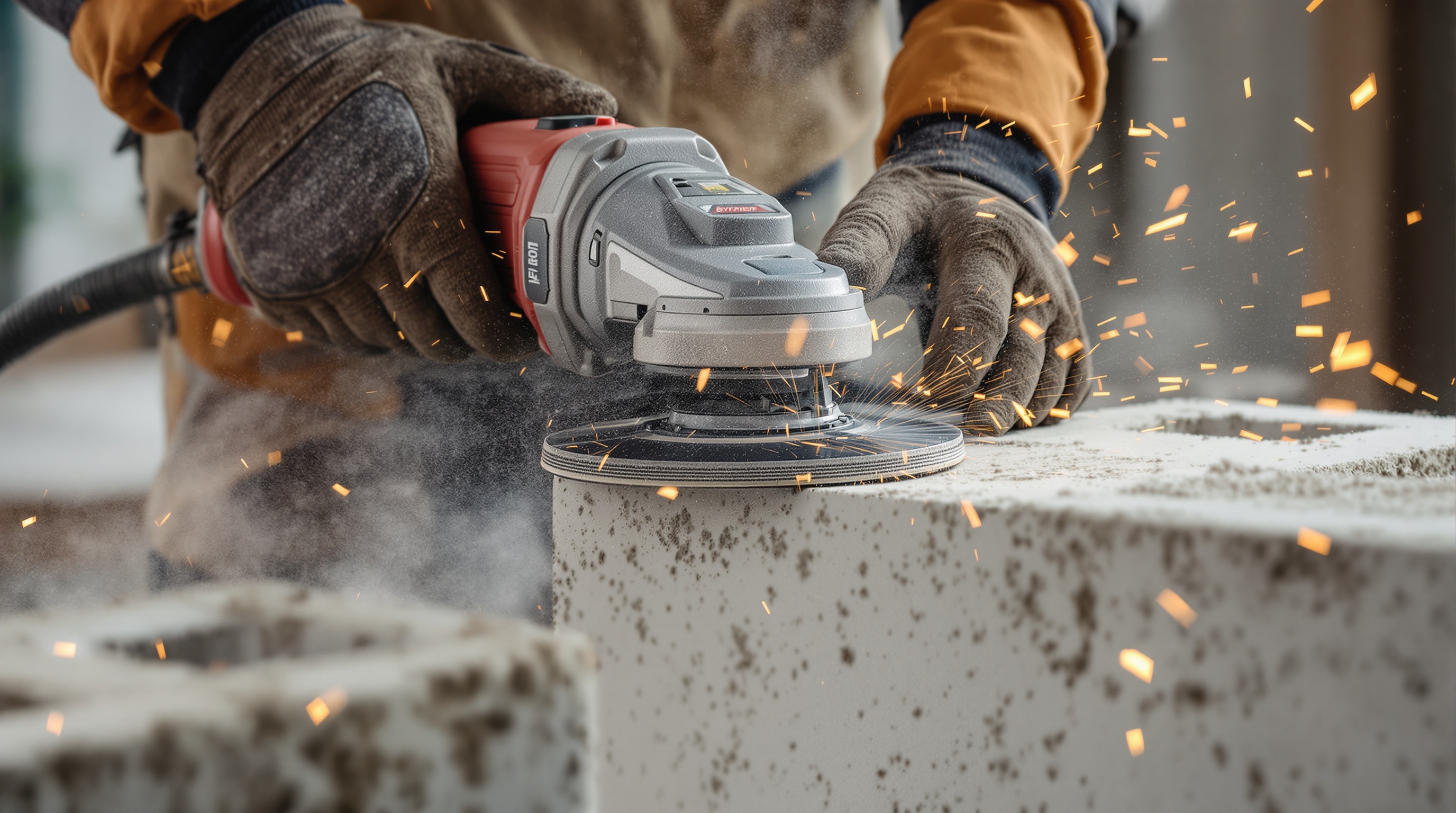
- Dust extraction is mandatory on commercial sites. OSHA Table 1 compliance requires a dust shroud connected to a HEPA-filtered vacuum. Dry-cutting without one packs the housing with abrasive dust (destroying the tool from the inside) and creates extra kerf friction that warps the blade.
- Support both sides of the cut. An unsupported slab can sag and pinch the blade in the kerf — the most common cause of dangerous binding and kickback.
- Verify before cutting rebar. A diamond blade will slice through rebar easily, but doing so on a structural slab can compromise its integrity — check engineering requirements first.
Cutting access channels for anchors or baseplates?
Once your concrete is cut and prepped, the free Anchor Specification Engine calculates the exact anchor size, embedment, and torque for the job per ACI 318-19.
Try the Anchor Specification Engine →Buying Advice
- General fabrication / all-around shop tool: A premium 4-1/2" or 5" corded grinder rated 11–13 amps from Metabo, DeWalt, or Makita handles 90% of cutting, grinding, and wire-wheeling needs.
- Field metalwork / mobility: DeWalt 60V Max FlexVolt or Milwaukee M18 FUEL — brushless cordless equivalent to 13–15 amp corded power.
- Deep concrete cutting / trenching: 7"–9" corded, 15 amps (Metabo WEPB 24-230, DeWalt DWE4597).
- Precision concrete / vertical & overhead cuts: 4.5"–5" corded, 11–13 amps (Bosch GWS13-50, Makita 9557PBX1).
Across all categories, avoid ultra-budget off-brand tools — an underpowered grinder on quarter-inch steel plate or cured concrete will bog down, overheat, and fail fast, and a failure under load (a shattered cutoff wheel, a bound diamond blade) is a genuine safety hazard, not just an inconvenience.
Conclusion
The same fundamentals — adequate amperage for the material, the right wheel or blade for the job, paddle switches and kickback brakes, and letting the tool's speed (not your body weight) do the work — apply whether you're beveling weld joints or chasing cracks in a slab. Match the grinder's size and power to your primary use case, invest in quality abrasives or diamond blades, and respect the dust and kickback hazards specific to each material.